


Page 149 - Demo
P. 149
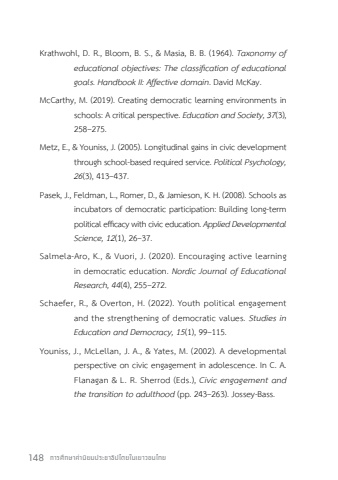
148 %u0e01%u0e32%u0e23%u0e28%u0e36%u0e01%u0e29%u0e32%u0e04%u0e48%u0e32%u0e19%u0e34%u0e22%u0e21%u0e1b%u0e23%u0e30%u0e0a%u0e32%u0e18%u0e34%u0e1b%u0e44%u0e15%u0e22%u0e43%u0e19%u0e40%u0e22%u0e32%u0e27%u0e0a%u0e19%u0e44%u0e17%u0e22Krathwohl, D. R., Bloom, B. S., & Masia, B. B. (1964). Taxonomy of educational objectives: The classification of educational goals. Handbook II: Affective domain. David McKay.McCarthy, M. (2019). Creating democratic learning environments in schools: A critical perspective. Education and Society, 37(3), 258%u2013275.Metz, E., & Youniss, J. (2005). Longitudinal gains in civic development through school-based required service. Political Psychology, 26(3), 413%u2013437.Pasek, J., Feldman, L., Romer, D., & Jamieson, K. H. (2008). Schools as incubators of democratic participation: Building long-term political efficacy with civic education. Applied Developmental Science, 12(1), 26%u201337.Salmela-Aro, K., & Vuori, J. (2020). Encouraging active learning in democratic education. Nordic Journal of Educational Research, 44(4), 255%u2013272.Schaefer, R., & Overton, H. (2022). Youth political engagement and the strengthening of democratic values. Studies in Education and Democracy, 15(1), 99%u2013115.Youniss, J., McLellan, J. A., & Yates, M. (2002). A developmental perspective on civic engagement in adolescence. In C. A. Flanagan & L. R. Sherrod (Eds.), Civic engagement and the transition to adulthood (pp. 243%u2013263). Jossey-Bass.


